
Women and families
Guide to Umrah with a disabled traveller: hotel, transport and accessibility at the Haram
7 min readShort answer
Travelling to the holy lands with a relative who is disabled or has limited mobility becomes an extremely peaceful and barrier-free experience of worship when it is planned well. The wide-ranging accessibility solutions Saudi Arabia has put in place across Masjid al-Haram, the Prophet’s Mosque and the transport networks, from wheelchair routes to dedicated lifts, offer great ease at every stage.
Can disabled people go on Umrah?
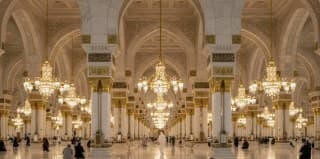
Yes. Disabled people can go on Umrah without any restriction, provided the necessary health and accessibility precautions are taken. Throughout Masjid al-Haram and the Prophet’s Mosque there are special entrances, ramps, lifts for disabled people and reserved worship lanes for visitors who use wheelchairs.
Thanks to the improved infrastructure, guests with a physical disability or limited mobility can follow a barrier-free route at every point, from the airport to the hotel, from intercity transport to the tawaf and sa’y areas. Having a companion with them will make the steps of worship much more comfortable.
What transport rights and facilities are offered to disabled people?
Disabled passengers have special assistance and accessibility rights across all transport networks, from air travel to intercity transfers. At airports, wheelchair (PRM) service is provided up to the aircraft door, while the high-speed train used between Medina and Makkah has dedicated wheelchair spaces and barrier-free carriage entrances for disabled passengers.
Steps that make the journey effortless:
- Airport PRM request: When booking the flight, notify the airline of the disabled passenger and request a wheelchair and an assistant for boarding and disembarking.
- High-speed train accessibility: The Medina–Makkah high-speed train has wide seats and wheelchair securing areas designed specially for disabled passengers.
What is free for disabled people at the Haram and the Prophet’s Mosque?
Inside Masjid al-Haram and the Prophet’s Mosque, manual wheelchairs, access ramps, dedicated lifts and accessible wudu areas for disabled visitors are entirely free of charge.
Free facilities available within the Haram:
- Manual wheelchairs: These can be obtained without paying any fee from the staffed points at the mosque courtyard entrances.
- Ramps and gates for disabled people: At the main entrances of Masjid al-Haram, such as the King Fahd and King Abdulaziz gates, there are step-free entrance routes suitable for wheelchair use.
- Reserved lanes in the Mataf and for sa’y: Special lanes are set aside for wheelchair users in the tawaf area around the Kaaba (the Mataf) and on the sa’y route between the hills of Safa and Marwah.
How should the hotel and room accessibility be for disabled travellers?
When travelling with a disabled traveller, it is critically important that the hotel you choose is right at the Haram courtyard, on level ground and has a step-free entrance. Inside the hotel, choose accessible rooms with wide lifts, thresholdless bathroom doors and grab bars.
Features to look for when booking an accessible hotel:
- Thresholdless, level entrance: The entrance to the hotel lobby should have no steps, or there should be a wheelchair ramp.
- Accessible bathroom: A shower seat, enough space for a wheelchair to turn and grab bars beside the toilet provide comfort.
Plan your Umrah on your own calendar
On this special journey with a relative who is disabled or has limited mobility, you do not have to fit in with others’ tight sightseeing programmes or struggle on crowded bus transfers.
With Zair, you can set every detail around your loved ones’ comfort, from your departure and return dates to choosing a fully accessible hotel close to the Haram, from wheelchair spaces on the high-speed train to visa follow-up. You focus on your worship, and Zair manages the operational processes.
The accessibility information in this guide is based on Saudi Arabia’s mosque accessibility services and the high-speed train transport regulations.